AI Has a Cloud Cost Problem: Why Shift-Left FinOps Matters More Than Ever

The Cost Everyone Is Watching–And the One They’re Missing
Generative AI has rapidly moved from experimentation to production. Today, organizations are embedding AI into customer support, software development, analytics, and business operations.
Most conversations around AI costs focus on tokens–the price of prompts and responses generated by large language models. While token consumption is important, it is often not the largest cost.
For many organizations, the faster-growing expense comes from the cloud infrastructure powering AI workloads: GPU instances, inference endpoints, training environments, vector databases, storage, and networking. As AI adoption grows, so does the cloud infrastructure required to support it.
The challenge is not that AI is expensive. The challenge is that AI infrastructure consumption often grows faster than the visibility and governance needed to manage it effectively.
A Familiar Pattern
This is not the first time organizations have faced this problem.
In the early days of cloud adoption, teams gained unprecedented speed and flexibility, but many struggled to understand where costs were coming from until invoices arrived. Over time, FinOps emerged as a discipline that brought visibility, accountability, and optimization to cloud spending.
AI is following a similar path.
Development teams are integrating AI services into applications, deploying new workloads, and experimenting with different models at an unprecedented pace. Innovation is accelerating, but governance is often lagging behind.
Without the right controls, organizations risk repeating the same cloud cost challenges they experienced years ago–this time at AI scale.
Why Traditional FinOps Isn’t Enough
Most FinOps practices are designed to analyze costs after resources are already running.
Dashboards and reports are valuable, but they are inherently reactive. They help organizations understand what happened, not necessarily prevent costly decisions before they occur.
With AI workloads, many of the most significant cost drivers are determined early in the development process:
- GPU and accelerated compute selections
- Autoscaling configurations
- Training environment sizing
- Infrastructure deployment choices
- Region and architecture decisions
These decisions are often defined in Infrastructure-as-Code templates, CI/CD pipelines, and Kubernetes configurations long before resources are deployed.
By the time costs appear on a dashboard, the expensive decision has already been made.
The Shift-Left FinOps Approach
To effectively manage AI infrastructure costs, organizations need to move cost awareness earlier in the development lifecycle. This is where Shift-Left FinOps becomes critical.
Instead of waiting for monthly reports or cloud invoices, cost intelligence should be available when engineers are designing, reviewing, and deploying infrastructure.
By bringing cost visibility directly into development workflows, organizations can identify expensive configurations before they reach production. An oversized GPU cluster, inefficient autoscaling policy, or unnecessary AI workload can be flagged during code review or deployment validation rather than after costs have already been incurred.
The result is simple: prevent avoidable spend before it happens.
Four Pillars of AI Cloud Cost Management
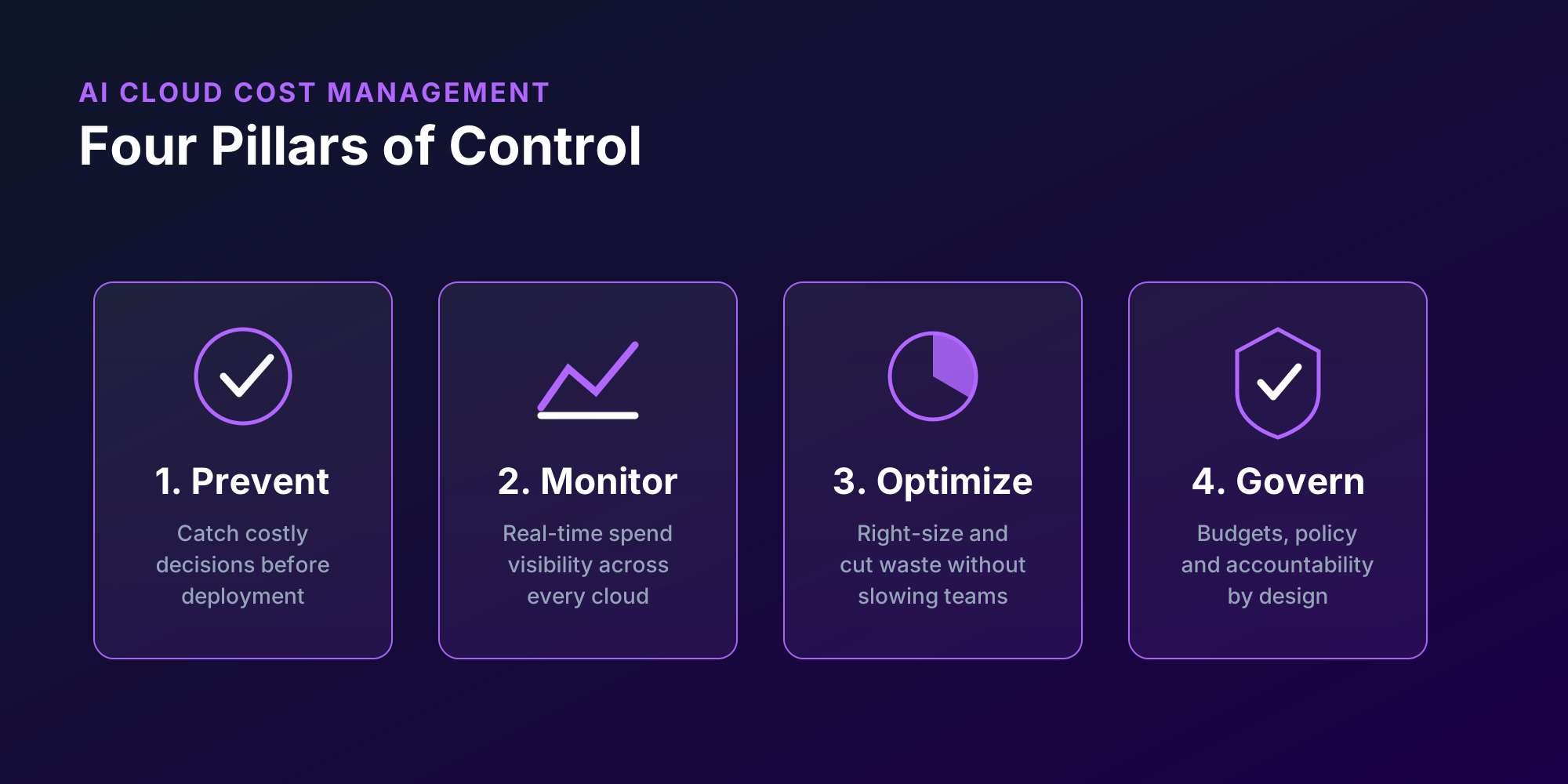
A mature approach to AI cost governance typically focuses on four key areas:
1. Prevent
Identify costly infrastructure decisions before deployment.
Cost guardrails integrated into CI/CD pipelines help teams evaluate infrastructure changes early and reduce financial risk before resources are provisioned.
2. Monitor
Gain real-time visibility into AI infrastructure spending across cloud environments.
Understanding where costs originate and how consumption patterns evolve matters for maintaining control as AI adoption grows.
3. Optimize
Continuously improve resource utilization, right-size compute capacity, and identify opportunities to reduce waste without impacting performance or innovation.
4. Govern
Establish budgets, policies, approval workflows, and accountability mechanisms that make sure AI investments align with business objectives.
From AI Adoption to AI Accountability
The first phase of generative AI focused on experimentation. The next phase is operationalization.
As organizations scale AI initiatives, leadership teams are increasingly asking critical questions:
- How much are we spending on AI infrastructure?
- Which teams and workloads are driving those costs?
- Are resources being used efficiently?
- What business value are we receiving from these investments?
- How can we scale AI responsibly without creating unnecessary financial risk?
Organizations that can answer these questions proactively will be better positioned to expand AI initiatives with confidence.
How SKYXOPS Helps
SKYXOPS extends FinOps principles to modern AI infrastructure across AWS, Azure, and GCP.
Through Shift-Left FinOps capabilities, organizations can identify cost risks before deployment, gain real-time visibility into cloud spending, and implement governance practices that support sustainable AI growth.
Addressing cloud costs before infrastructure reaches production is what changes the outcome.
Final Thoughts
AI is rapidly becoming one of the largest contributors to cloud spending. While organizations continue to focus on token costs, the underlying infrastructure powering AI often represents an even greater financial challenge.
The organizations that succeed with AI will not simply be those that adopt it fastest. They will be the ones that combine innovation with financial accountability.
The future of AI cost management is not only about understanding spend after deployment. It is about making cost-aware decisions before deployment happens.